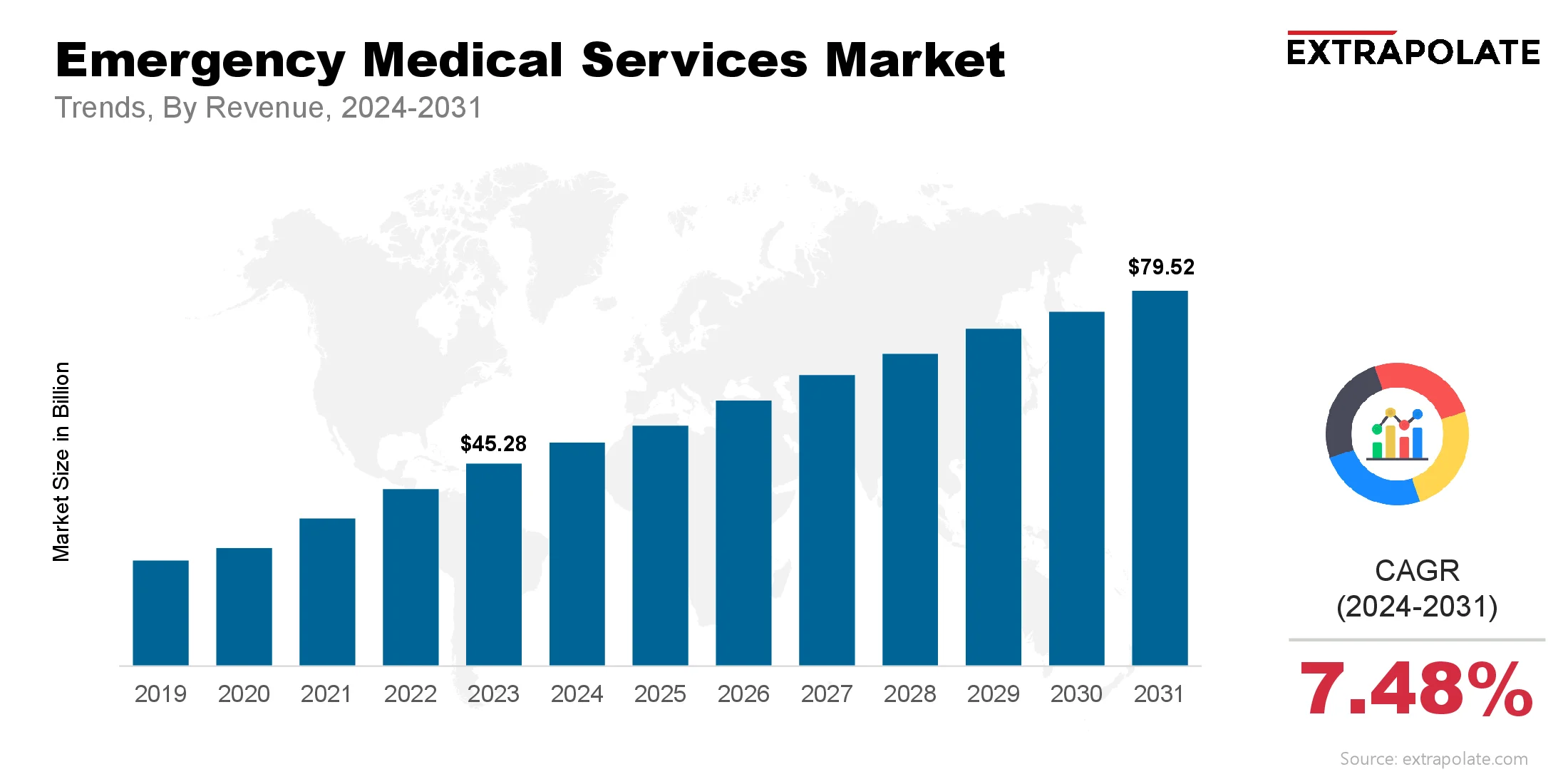
Emergency Medical Services Market Summary-
As per Market Research Future
analysis, the Emergency Medical Services Market Size was estimated at 46.5 USD
Billion in 2024. The Emergency Medical Services industry is projected to grow
from 48.79 USD Billion in 2025 to 78.87 USD Billion by 2035, exhibiting a
compound annual growth rate (CAGR) of 4.92% during the forecast period 2025 -
2035
Key Market Trends & Highlights
The Emergency Medical Services
Market is experiencing a transformative phase driven by technological
advancements and evolving healthcare needs.
·
Technological integration is reshaping service
delivery in the Emergency Medical Services Market, particularly in North
America.
·
A growing focus on mental health is influencing
emergency response protocols, especially in the Asia-Pacific region.
·
Collaborative approaches among healthcare
providers are becoming increasingly prevalent, enhancing patient outcomes in
hospitals and trauma centers.
·
The increasing demand for emergency medical
services, coupled with regulatory support and funding, is driving growth in
both cardiac care and trauma injuries segments.
Emergency Medical Services Market
CAGR 4.92%
Major Players
American Medical Response
(US), Falck (DK), Acadian Ambulance Service (US), London Ambulance Service
(GB), Zoll Medical Corporation (US), MedStar Mobile Healthcare (US), Priority
Ambulance (US), Samaritans Purse (US), St John Ambulance (GB)
Emergency Medical Services Market Trends
The Emergency Medical Services
Market is currently experiencing a transformative phase, driven by advancements
in technology and an increasing emphasis on patient-centered care. The
integration of telemedicine and mobile health applications is reshaping how
emergency services are delivered, allowing for quicker response times and
improved patient outcomes. Furthermore, the growing awareness of the importance
of mental health in emergency situations is prompting services to adapt their
protocols and training to better address psychological needs. This evolution
reflects a broader trend towards holistic care in emergency medical settings.
In addition, the Emergency Medical Services Market is witnessing a shift
towards enhanced collaboration among various stakeholders, including hospitals,
government agencies, and private organizations. This collaborative approach
aims to streamline operations and improve resource allocation, ultimately
leading to more efficient emergency response systems. As the landscape
continues to evolve, the focus on sustainability and environmental
considerations is also becoming more pronounced, with services exploring
eco-friendly practices and technologies. Overall, the Emergency Medical
Services Market appears poised for continued growth and innovation, driven by
these emerging trends and the ongoing commitment to improving patient care.
Technological Integration
The incorporation of advanced
technologies, such as telemedicine and mobile applications, is revolutionizing
the Emergency Medical Services Market. These innovations facilitate real-time
communication between emergency responders and healthcare providers, enhancing
decision-making and patient management during critical situations.
Increasing Demand for Emergency Medical Services
The Emergency Medical Services
Market is experiencing a notable surge in demand, driven by a rising population
and an increase in chronic diseases. As urbanization continues to expand, the
need for timely and efficient emergency medical care becomes paramount. Reports
indicate that the number of emergency calls has risen significantly, with some
regions reporting increases of over 20% in the last few years. This heightened
demand necessitates the expansion of emergency medical services, including the
deployment of more ambulances and trained personnel. Furthermore, the aging
population is likely to contribute to this trend, as older individuals
typically require more frequent medical attention. Consequently, the Emergency
Medical Services Market is poised for growth as healthcare systems adapt to
meet these evolving needs.
Technological Advancements in Emergency Medical Services
Technological innovations are
reshaping the Emergency Medical Services Market, enhancing the efficiency and
effectiveness of emergency care. The integration of advanced communication
systems, such as real-time data sharing and GPS tracking, allows for quicker
response times and improved patient outcomes. Moreover, the adoption of
telemedicine in emergency services is gaining traction, enabling paramedics to
consult with physicians during transport. Data suggests that the implementation
of these technologies can reduce response times by up to 30%, significantly
impacting patient survival rates. As technology continues to evolve, the
Emergency Medical Services Market is likely to see further enhancements,
including the use of artificial intelligence for predictive analytics and
resource allocation.
Regulatory Support and Funding for Emergency Medical Services
Government initiatives and
regulatory support play a crucial role in shaping the Emergency Medical
Services Market. Increased funding for emergency medical services is being
observed, as governments recognize the importance of robust emergency care
systems. For instance, various countries have implemented policies aimed at
improving the infrastructure and training of emergency medical personnel. This
financial backing is essential for upgrading equipment and expanding service
coverage, particularly in underserved areas. Additionally, regulatory
frameworks are evolving to ensure that emergency medical services meet high
standards of care. As a result, the Emergency Medical Services Market is likely
to benefit from enhanced operational capabilities and improved service
delivery.
Integration of Mental Health Services in Emergency Medical Response
The integration of mental
health services into the Emergency Medical Services Market is becoming
increasingly relevant. As mental health issues gain recognition, emergency
medical services are adapting to address these needs effectively. This shift
involves training emergency personnel to recognize and respond to mental health
crises, thereby improving overall patient care. Reports indicate that
approximately 20% of emergency calls involve mental health-related issues,
highlighting the necessity for specialized training and resources. By
incorporating mental health services, the Emergency Medical Services Market can
provide more comprehensive care, ultimately leading to better outcomes for
patients. This trend suggests a potential for growth as services evolve to meet
the complex needs of the population.
Market Segment Insights
Emergency Medical Services Market End User Insights
Based on end users, the emergency medical services market segmentation
includes hospitals & trauma centers, and ambulatory surgical centers. The
hospitals & trauma centers segment held the majority share in 2021,
contributing to around ~60-63% of the emergency medical services market
revenue. The rapidly increasing prevalence of chronic conditions and trauma
injuries, as well as an increase in government investments, funds, and grants
for hospital infrastructure development worldwide, are the major factors
driving the expansion of this market segment.